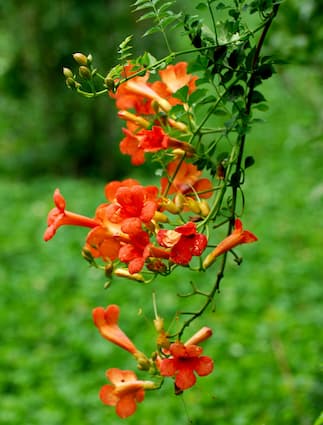
If you’re growing Trumpet Flower Vine plants, you are in for a treat. The plant is a member of the begonia family. This plant will make you into a hummingbird lover. In addition, the profuse blooms attract other pollinators. This fast-growing, flowering vine has a trumpet shape that attracts hummingbirds in big numbers. Everyone who sees it in your yard, calls it by a different name. Most commonly the word “trumpet” is in the name. It’s understandable if you are a little confused about exactly what to call it. We will help to take a little of the confusion out….just a little.
Trumpet flowers are also sometimes called “Cow Itch”. As a member of the nightshade family, the leaves have a toxic substance that can cause itching and a rash.
Did You Know? Trumpet Vine Flowers are a highly flammable plant. Consider this fact if you live ina an area where fire risk is high.
Trumpet Flower Vine Plant Specifications
Flower Colors: Red, yellow-orange, yellow.
Flowers Bloom: Late Spring to Summer
Plant height: Vines grow up to 40 feet in a season.
The first is Trumpet Creeper (Campsis Radicans). It can grow 30-40 feet in a season, with a trunk several inches across. Its three-inch blooms appear in the summer, earlier in the south. Colors range from yellow and yellow-orange to red. This plant is native to the U.S. Gulf Coast and the southeastern U.S.
A close relative is the Cross Vine (Bignonia Capriolata). Cross Vine is also commonly called Trumpet Flower, or Trumpet Vine. Cross vines grow shorter vines. The flowers are smaller, growing two to three inches. It blooms early in the spring and helps to attract returning hummingbirds to your yard for the season. Cross Vines are native to a large area of the U.S. from the mid-Atlantic states and south to Florida, and west to mid-western states.
As a flowering vine, they need some type of support to climb. In the wild, they grow up tree trunks. They will look good growing in this manner in naturalized settings. A trellis or fence works well, too. Fences are more popular, as it provides longer length to run the vines. The support should be big enough to support vine growth of up to 30-40 feet, depending upon what trumpet flower variety you are growing.
Plants can be invasive. Growing methods are the same for both types of Trumpet Flower Vines.
Are Trumpet Flower Vines Edible?
NO!
If you’re hungry, don’t think about munching on Trumpet Flower Vines. These plants are mildly toxic. Consumption can cause abdominal pains, nausea, and vomiting. Also, it causes skin rashes and irritation.
Keep children, pets, and other animals away from this plant.
Medicinal Uses
Despite being a toxic plant, it has a variety of traditional and medicinal home remedy applications. Here are some of them:
The sap is used for skin ailments.
Use it as a treatment for diabetes.
It treats menstrual disorders.
Treat digestive disorders.
Important Note: As a toxic plant we strongly recommend you do not make home remedies from this plant without the proper training.
Light Requirements
Select a location where the plant will receive full, direct sunlight. Give the plant six to eight hours of bright, direct sun.
The plant will also grow in partial sunlight. However, too little sun results in fewer blooms.
Trumpet Flower Vine Plant Propagation
Trumpet Flower Vine are grown from seeds. Sow seeds directly into your flower garden after all danger of frost have passed and the soil has warmed. Plant seeds 1/4″ deep.
Vines can also be propagated by digging up and replanting suckers.
Days to Germination: Seeds sprout in 14 – 21 days.
Trumpet Flower Vines are easy to grow. They prefer full sun but will tolerate partial shade. Plants need rich soil to fuel their fast growth. Mix a healthy dose of compost into the soil before planting. Apply a general-purpose fertilizer after planting. Then, water the planting site.
Fertilizer needs:
Any plant that grows thirty or forty feet in a single season requires a lot of fertilizer to reach its full potential. Add general-purpose fertilizer every two to three weeks during the season. Switch to a high-phosphorous formula just before the blooming period.
You can also apply a liquid fertilizer for a quick boost. Apply it to the planting site and to the leaves.
Water needs:
Trumpet Flower Vines need lots of water for maximum growth potential. However, do not leave the soil soggy. Keep the soil evenly moist, but not wet, during the growing season.
Other steps:
Trumpet Flower Vine needs some form of support to climb up. Trellises or fences work well. It is important to train the vines to go where you want them to go.
Keep the areas weeded when plants are young. A layer of mulch will keep weeds down, and create a neat appearance.
Trumpet Flower Vine can be invasive. Contain their spread with border edging partially buried two t three inches below the soil level.
They are good “re-seeders”. If the pods are allowed to open and pour out their seeds, you will find many new plants next year. Do not disturb the soil until seedlings have begun to grow. Thinning will almost certainly be needed. If you don’t want them to spread too rapidly, pick seed pods as they appear.
Trumpet Flower vines can cause skin irritation. So, we recommend wearing gloves when handling this plant.
Pruning
Trumpet Flower vines benefit from an aggressive pruning regimen. The plant can become dense. Pruning away some of the growth allows better air circulation and reduces the risk of plant disease. You can also prune vines that are going in the wrong direction or have reached the limit of where you want them to grow. Also, the removal of some of the foliage allows the plant to focus on the production and development of flower buds and blooms.
You should deadhead spent blooms as soon as the flower withers. This encourages the plant to produce new blooms.
If you want to harvest some of the seeds, leave a few spent blooms on a couple of the plants.
How to Grow Trumpet Flower Vine Plants in Flowerpots and Containers
Trumpet Flower Vines are not commonly grown in containers. But, with a big flowerpot, you can grow them almost anywhere. They will need something to climb. Or, let them cascade down from your balcony or raised deck.
Here are a few additional steps:
Use rich planting soil for the container.
Select a sunny location on your balcony or deck.
It is important to have a drain hole in the container to allow excess water to drain from the pot.
The plant grows best in moist soil. Keep an eye on the moisture level. Check the plants every few days, especially in extended periods of hot, dry weather.
When watering the plants, thoroughly wet the soil. Excess water will drain through the hole in the bottom of the flowerpot.
Nutrients in a flowerpot are limited. So, use fertilizer spikes to feed the plants. Or, apply a light solution of liquid fertilizer every two to three weeks.
Insects and Plant Disease
Insect and disease problems are uncommon. Use insecticidal sprays or fungicides only if needed.
Also see: Plant Problems – Identify the causes and find the cures.