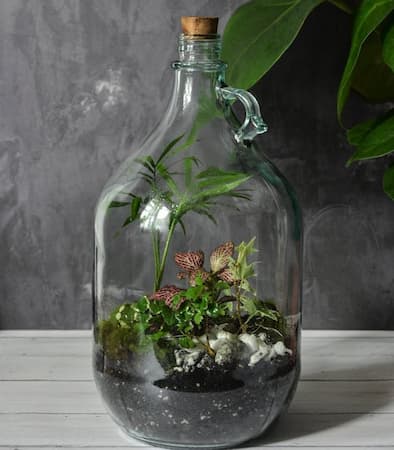
Houseplant terrariums are miniature, self-contained ecosystems. Once created, these closed environments can go for months unattended, without even adding water. Avid gardeners enjoy houseplant terrariums, to extend their gardening season year-round. The only disadvantage for the active gardener is once the terrarium is established, neglect is often the best method of care. Terrarium plants are right at home in the self-sustaining environment.
You can buy a terrarium kit from a garden store. Or, build your own. Either way, you are enjoying the hobby of gardening, only you are doing so indoors. And, while you are at the garden store, select terrarium plants.
History of Terrariums
The history of Terrariums goes back to the early 1800s. Dr. Nathaniel Ward, a London physician, discovered it by accident in 1827. While experimenting with cocoons in covered jars, he found tiny plants growing in the soil in the jar. While many plants in his backyard died from the polluted air in London, these covered plants actually thrived. He then experimented successfully with covered containers for ferns. Covered containers became popular and were called a Wardian case, the first terrariums.
How Terrariums Work
Terrariums are a self-contained environment. Once they are established, they need nothing from the outside except a little indirect sunlight. Terrariums do not even need water for a long period.
Moisture in the Terrarium evaporates from the soil and plant leaves. It condenses on the Terrarium roof and walls. Then, condensed water falls down and re-moistens the soil in a continual, closed-loop process. As long as the top is sealed, this process will continue for months, perhaps even years.
Types of Containers
A good container for terrariums is anything that is clear to slightly opaque, and either has a cover, or a cover can be placed upon it. When selecting the perfect terrarium, look for a glass or plastic container that fits the decor of the room you will keep it in.
The opening at the top can be big or small.
Selecting the Right Terrarium Plants
The first thing to do in selecting plants is to think small. Garden stores should have a good selection of plants. The best candidates should begin small, grow slowly, and remain small. Otherwise, the Terrarium can be quickly overgrown.
Select a variety of plants with contrasting colors and shapes. If you are using landscaping, pick plants that blend well with the landscape. If you pick the same color and little variety, then your display will look plain and dull.
Make sure the plants are disease and insect free, with healthy, green (not yellowing) leaves.
Because your environment will be moist, sub-tropical plants thrive best. Also, look for terrarium plants that do well in partial light, or shady conditions. Do not select plants that are susceptible to disease in moist conditions.
Did you know? Before going into the woods to pick some ferns for your Terrarium, read up on local flora. Certain types of Ferns are endangered species. Disturbing or possessing them carries a stiff fine.
How to Make a Terrarium
You can design and make your own terrarium. Or, you can buy a trerrarium kit from a garden store. Assemble your materials. If you are using a container with a small or narrow top, you will need tweezers, long sticks, and a long, thin spoon. You may need to improvise and tape a spoon to the stick. We recommend sterilizing all tools, the terrarium, and ingredients before planting.
Add materials as follows:
First, add 1/2 to 1 inch of coarse builders’ sand, gravel, or pebbles. This is the drainage layer that captures excess moisture.
Next, add a thin layer of charcoal granules. This keeps odors from developing.
Add a layer of Sphagnum Moss. This serves to keep soil from seeping into the drainage layer.
Finally, add 1/2 to 1 inch of well-draining, fertile potting soil.
You are now ready to landscape and plant.
Add rocks and other landscaping as desired. If you want to create small hills, add soil where needed to create the effect of a hill.
Plant your plants carefully. Create a small hole and set or tip your plant in. Make sure all roots are in the hole. Fill soil on and around the roots and tamp down lightly. Give space to grow between plants.
Tip: Slightly ball the roots for easier planting.
Water and Nutrients
After planting, mist the sides of the container to clean off excess soil. Add a couple of ounces of water, depending upon the size of the container. It is best to spray it into the container rather than pouring it in. Close the container and check it daily for the first few days. If the soil appears too dry, add a little water. If it appears too moist, take the top off for a while to allow some evaporation.
Do not add fertilizer. Good potting soil should contain enough minerals for the environment.
Terrarium Care and Maintenance
Now comes the hard part. After your Houseplant Terrarium has settled in for a few days and is established…..leave it alone and covered. This is the best treatment. It should remain self-contained for months or even more than a year.
It is important to keep your Terrarium out of direct sunlight. A little direct sunlight can cause temperatures in the enclosed environment to rise rapidly.
If the leaves begin to yellow after a few months, add a little water-soluble fertilizer.
Remove any dead plants and leaves. Prune back excessive growth, as needed.
Otherwise, only open the lid to allow excess moisture to escape.
Did you Know? A Desertarium is a self-contained environment for plants that thrive in dry, arid, or desert-like conditions. Unlike Terrariums, a Desertarium should be left uncovered to allow moisture to escape.
Today's Gardening Tip
Without a doubt, squirrels can be a real pest at your bird feeder. Often, bird watchers seek ways to control and rid their yard of squirrels. more ……
Related Articles
Additionally, people who read this article on terrariums will also like: